SaaS Development
How Much Does It Cost to Build a SaaS MVP in 2026? Real Numbers, Hidden Costs and a Worked Example
A SaaS MVP can cost anywhere from $3,000 to $120,000+. Here is why the quotes differ so much, what is usually left out, and a line-by-line worked example you can adapt.

Article summary
Key takeaways
- Published 2026 ranges for a SaaS MVP run from a few thousand dollars (solo founder with a starter kit) to well over $100,000 (agency-built, complex or compliance-heavy products). Most simple-to-medium B2B MVPs land between roughly $15,000 and $80,000, depending on who builds them.
- Who builds it moves the price more than any feature. The same scope can differ 5x or more between a freelancer, a small studio, and a large agency.
- Budget for year one, not just the build. Maintenance alone is commonly estimated at 15–20% of the build cost per year.
- The most commonly forgotten items: an admin panel, transactional emails, roles and permissions, data import, backups and monitoring, third-party fees, and the cost of a proper handover.
- A cheap quote is not automatically a bad one, but a quote with no stated assumptions always is. Ask what is not included.
Real numbers, hidden costs, and a worked example you can adapt to your own idea.
Ask five agencies what a SaaS MVP costs and you will get five answers, often more than ten times apart. That is not because anyone is lying. It is because "MVP" is not a product. It is a scope decision, and the price follows the scope, the team, and the quality bar you choose.
This guide gives you the ranges, explains what actually moves the price, shows the costs that rarely appear in quotes, and walks through a complete worked estimate so you can budget with your eyes open.
The short answer: what the market is quoting
Here is what published 2026 guides say. Notice how widely they disagree:
| Source type | Quoted range | What it usually means |
|---|---|---|
| Solo founder with a starter kit | $1,000 – $10,000 (2–6 weeks) | You do most of the work; limited custom features |
| Small MVP from a developer or small team | $3,000 – $7,000 (one guide) | One core workflow, basic auth and dashboard |
| Mid-level freelancer (Eastern Europe / Latin America) | $16,000 – $30,000 for an MVP at $40–$60/hr | One person, one stack, you manage the project |
| "Simple SaaS MVP" from agencies | $15,000 – $50,000 | Core workflow, auth, billing, basic admin |
| Mid-size product | $50,000 – $150,000 | Several workflows, roles, integrations, reporting |
| Complex or compliance-heavy platform | $150,000 – $400,000+ | Multi-tenant at scale, regulated data, heavy integrations |
Ranges compiled from published 2026 guides including DesignRevision (opens in a new tab), Guru TechnoLabs (opens in a new tab), Purrweb (opens in a new tab) and Cleveroad (opens in a new tab). They are marketing material from vendors, so treat them as market signals, not price lists.
Why the ranges are so different
Three reasons explain almost all of the gap:
- Different definitions of "MVP." One team means a clickable prototype with login. Another means a production-ready multi-user product with billing, roles, and monitoring.
- Different labor markets. Hourly rates differ by 5–10x across regions (more on this below).
- Different assumptions about what you already have. Do you have designs? A written spec? A data model? Every gap you leave is paid for in discovery time.
So the useful question is not "what does an MVP cost?" It is "what does my MVP cost, built this way, to this quality?" The rest of this article helps you answer that.
Four ways to build, and what each really costs
| Build path | Typical cost | Typical timeline | Main risk |
|---|---|---|---|
| 1. Solo founder + starter kit | $1,000 – $10,000 | 2 – 6 weeks | Your time, and hitting the limits of the kit |
| 2. Freelancer | $10,000 – $30,000 | 6 – 14 weeks | Single point of failure; you manage everything |
| 3. Small studio / boutique agency | $15,000 – $60,000 | 8 – 16 weeks | Fit and communication; check who actually builds |
| 4. Large agency | $60,000 – $150,000+ | 12 – 24 weeks | Overhead, slower changes, juniors behind senior names |
Timelines are typical ranges from our experience and published guides; yours will vary with scope.
Starter kits (pre-built SaaS foundations with login, billing and a dashboard) are the biggest single cost lever in 2026. If your product is a fairly standard SaaS shape, starting from a kit can remove weeks of work. The catch: you inherit its structure, so a product with unusual workflows can end up fighting the kit.
Freelancers are the cheapest professional option, but you carry the project management, and if they disappear mid-build you are in trouble. Ask who owns the repository and the cloud accounts from day one.
Small studios often hit the sweet spot for B2B MVPs: more than one person, defined process, and rates well below large agencies.
Large agencies make sense when you need compliance paperwork, dedicated account teams, or speed through headcount. For a first MVP, they are usually more than you need.
What actually drives the price
Eight factors decide where your quote lands:
- Number of distinct user roles (admin, manager, customer, vendor). Each role multiplies screens and permission logic.
- Core workflow complexity. One clean workflow is cheap. Five interdependent ones are not.
- Integrations. Payments, accounting, CRM, WhatsApp, email, shipping, SMS. Each integration is a mini-project with edge cases.
- Multi-tenancy. If many companies use the product with fully separated data, the architecture must enforce isolation. Adding it later is painful.
- Billing model. Flat subscription is simple. Usage-based, per-seat, trials, proration, coupons, and tax add real work.
- Design depth. A clean template-based UI costs far less than fully custom design systems.
- Data and compliance. Health, finance, and children's data raise the cost of security, audit logs and documentation.
- AI features. Adding AI is not just calling an API. See the AI section below.
A worked example: a simple B2B SaaS MVP, line by line
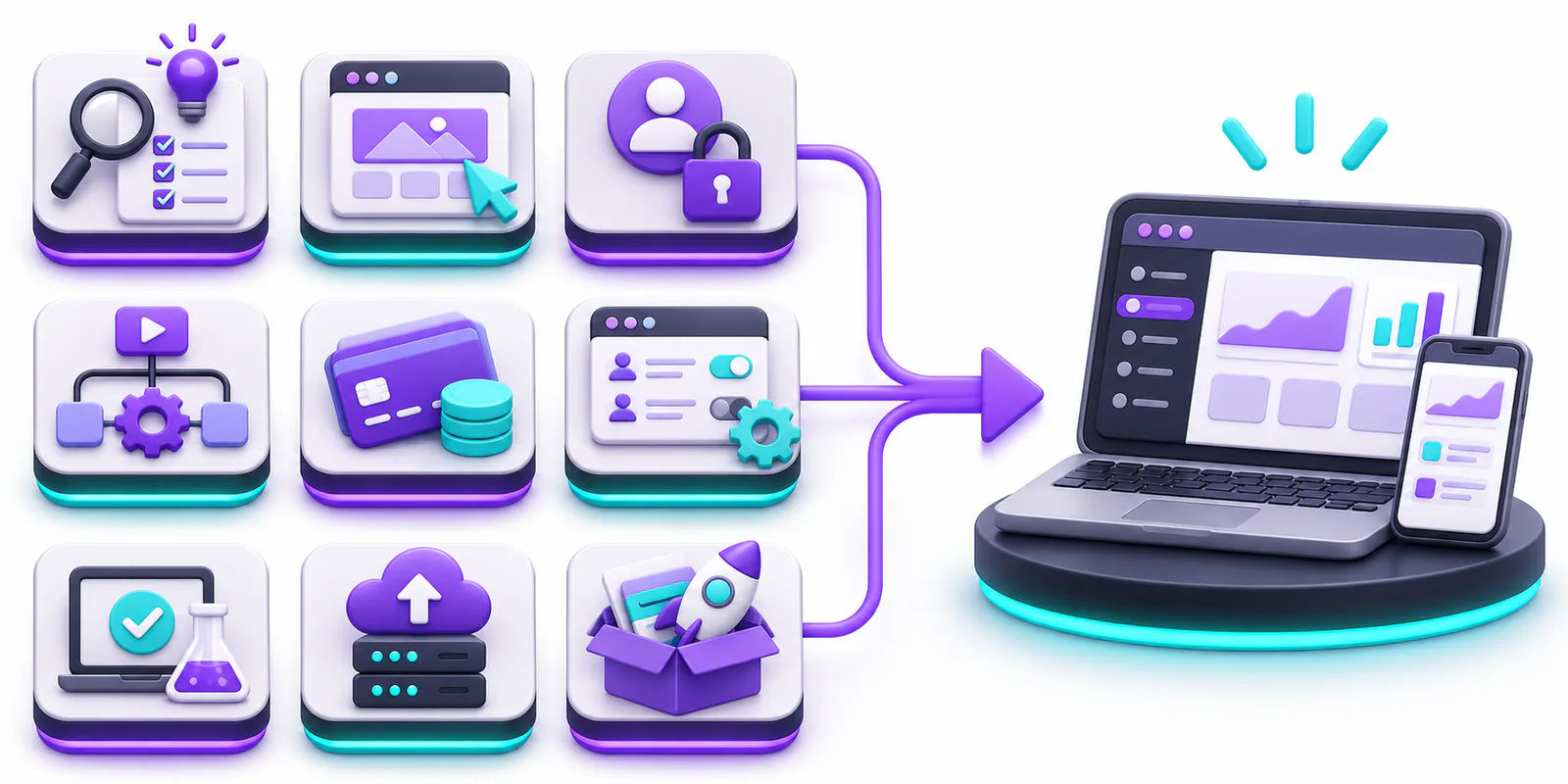
Most cost articles stop at the ranges. Here is what is missing: a transparent breakdown. This is an illustrative estimate, not a quote, for a typical simple B2B product (think a client portal with subscription billing: one core workflow, two user roles, Stripe billing).
| Work item | Hours |
|---|---|
| Discovery, scoping and wireframes | 40 |
| UI/UX design (about 12 core screens) | 50 |
| Authentication, invites, two roles | 30 |
| The core workflow (the one thing the product does) | 120 |
| Dashboard and basic reporting | 40 |
| Subscription billing and webhooks | 40 |
| Transactional emails and notifications | 20 |
| Admin panel | 40 |
| Testing and QA | 60 |
| Deployment, CI/CD, backups, monitoring | 30 |
| Project management and communication | 50 |
| Total | 520 hours |
Now multiply by the rate your builder charges:
| Hourly rate | Build cost for 520 hours | Add 15% contingency |
|---|---|---|
| $30/hr | $15,600 | $17,940 |
| $50/hr | $26,000 | $29,900 |
| $100/hr | $52,000 | $59,800 |
| $150/hr | $78,000 | $89,700 |
The same scope costs between roughly $16,000 and $90,000 depending purely on who builds it. That spread lines up with the market ranges above, which is the point: most of the "mystery" in SaaS pricing is the rate card.
Use this table as a template. Replace the work items with your own features, ask for hours per item, and compare quotes line by line.
The costs nobody puts in the quote

This is the gap in most cost guides. These items are real, frequently skipped, and often discovered after launch.
Build-side items often missing from quotes
- Admin panel. You need a way to see users, fix data, issue refunds, and support customers. It is often 5–10% of the build and rarely itemized.
- Roles and permissions. "Admin and user" turns into "admin, manager, viewer, billing contact" faster than expected.
- Email infrastructure. Welcome, reset, invoice and notification emails need templates, a sending service, and proper domain setup so they do not land in spam.
- Data import and export. Customers will want to bring data in and take it out.
- Legal pages and consent. Terms, privacy policy, cookie consent. These need a lawyer's review, not just a template.
- Audit logs. Essential for B2B trust, rarely scoped in the first quote.
- Search, filters and pagination. Small features that eat days.
- Documentation and handover. Without it, you pay again when a new developer takes over. We cover this in our software handover checklist.
Run-side items (monthly or annual)
- Hosting and database
- Email and SMS sending
- Error monitoring and logging
- Authentication or other third-party services
- Payment gateway fees (a percentage of revenue plus a fixed fee per transaction)
- Domain, SSL and backups
- AI usage fees if you call a language model (these scale with usage)
As a rough ballpark, many early-stage SaaS products spend $100–$500 per month on infrastructure and tools before they have significant traffic. Costs rise with users and data, so check current pricing from each provider.
Your real year-one cost
Build cost is only the first line. A realistic year-one budget looks like this:
| Line | Example (based on the $50/hr build) |
|---|---|
| MVP build | $26,000 |
| Contingency (15%) | $3,900 |
| Maintenance, bug fixes, dependency updates (15–20% of build per year) | $3,900 – $5,200 |
| Hosting and tools (about $100–$500/month) | $1,200 – $6,000 |
| Legal review, domain, misc. | $500 – $2,000 |
| Year-one total | about $35,500 – $43,000 |
The 15–20% maintenance figure comes from published guidance such as NeedleCode's 2026 breakdown (opens in a new tab). It exists because libraries, security standards, and hosting platforms keep changing even if you never add a feature.
Also plan for post-launch iteration. The first version teaches you what users actually want. Many founders keep 20–30% of the build budget in reserve for the first round of changes after real users arrive.
Why rates differ so much by region (and what you trade off)
Published 2026 data shows large differences:
- Freelance developers in the US and Canada average roughly $82–$130/hr, while senior freelancers in Pakistan average roughly $20–$45/hr (Arc (opens in a new tab)).
- At the agency level, one survey-based roundup lists roughly $150–$300/hr in the US, $50–$120 in Eastern Europe, and $25–$75 in India (FullStack (opens in a new tab)).
Lower rates are real, but they are not the whole story. What you should compare is cost per delivered, maintainable outcome, not cost per hour. Evaluate any team, anywhere, on:
- Communication: Do you get a named contact, written updates, and answers within a working day?
- Overlap hours: How many hours per day overlap with your time zone? Many teams adjust their schedules; ask.
- Process: Is scope, acceptance and change-request handling written down?
- Ownership: Will the code, cloud accounts and documentation be in your name?
- Evidence: Can they show relevant work, references, or a paid pilot?
A good team at $40/hr with clear process often beats an unclear team at $150/hr. The reverse is also true. Do not choose on rate alone.
How AI features change the cost
In 2026 many founders want AI in the MVP from day one. Sometimes that is right. Often it is a distraction. AI adds cost in four places:
- Design and prompt work. Getting reliable outputs takes iteration, not one API call.
- Evaluation. You need test cases to know whether the AI is correct, and to catch regressions when the model changes.
- Guardrails and human review. For anything consequential, a person should approve the output.
- Running cost. Model usage fees scale with every request. Set usage caps and monitor spend.
A good rule: if your product still works when the AI feature is switched off, build the core first and add AI in version two.
10 ways to cut cost without cutting quality
- Solve one painful problem. Cut every feature that does not serve it.
- Use proven building blocks for auth, billing, email and file storage instead of building them.
- Start from a good starter kit if your product fits a standard shape.
- Use template-based UI for the first release; invest in custom design after validation.
- Fix the scope, not the date. Ask what you can drop to hit the budget.
- Do discovery first as a small paid phase. A clear spec is the cheapest insurance you can buy.
- Defer integrations. Launch with CSV import, then integrate when customers ask.
- Write acceptance criteria up front so "done" is not a negotiation.
- Choose boring technology your team knows well.
- Build the admin panel early, so you can support users without developer help.
How to read a quote: red flags and green flags
Red flags
- A single number with no breakdown or assumptions
- "Unlimited revisions" with no defined scope
- A price far below every other quote and no explanation
- No mention of testing, deployment, or documentation
- The agency, not you, owns the cloud accounts or the code repository
- Pressure to sign quickly or pay everything upfront
Green flags
- Itemized estimate with hours or milestones
- Stated assumptions and exclusions
- A defined acceptance process for each milestone
- A clear plan for handover and post-launch support
- Willingness to start with a small, paid discovery phase
12 questions to ask before you sign
- What exactly is included, and what is explicitly excluded?
- Who will actually build this, and can I meet them?
- How are changes to scope priced?
- What does "done" mean for each milestone?
- Who owns the code, the repository, and the cloud accounts?
- How is testing handled? Is there automated testing?
- What will running costs be after launch?
- What happens if a team member leaves mid-project?
- How are security basics handled (access control, backups, secrets)?
- What documentation will I receive?
- What does post-launch support look like, and what does it cost?
- Can I speak to a past client?
Payment structures compared
| Model | Best for | Watch out for |
|---|---|---|
| Fixed price | Well-defined scope | Change requests; vendors cutting corners to protect margin |
| Time and materials | Evolving scope | Budget creep; needs a cap and weekly reporting |
| Milestone-based | Most MVPs | Milestones must have written acceptance checks |
| Retainer | Ongoing development | Make sure hours and deliverables are visible |
For most first MVPs, milestone-based payment with written acceptance checks is the fairest approach for both sides.
How long does it take?
Typical timelines, assuming scope is clear:
- Starter-kit-based simple MVP: 2–6 weeks
- Custom simple B2B MVP (like the example above): 8–14 weeks
- Mid-size product: 4–6 months or more
Delays almost always come from unclear scope, slow feedback, and late-discovered integrations, not from coding speed.
How Macro Encode approaches MVP scoping
We start with the user, the workflow, and the constraints, then choose the smallest suitable path to something real. In practice that means:
- A short discovery phase to clarify who it is for, what is not working, and what a useful outcome looks like
- Scope and acceptance checks agreed before delivery is evaluated
- Visible milestones, decisions and dependencies throughout the build
- A practical handover: deployment, documentation, and ownership
If you have an idea and want a realistic budget, a focused technical discovery is the fastest way to get one.
Ready to get a realistic estimate?
Tell us who it is for, what is not working, and what a useful outcome looks like. We will recommend a practical way forward, with scope, milestones, and a clear handover.
Sources and notes: market ranges and rates are drawn from published 2026 guides by DesignRevision, Guru TechnoLabs, Purrweb, Cleveroad, NeedleCode, Arc and FullStack, linked above. Hour breakdowns and the worked example are illustrative estimates, not quotes. Prices change; verify current rates and third-party pricing before budgeting.
Common questions